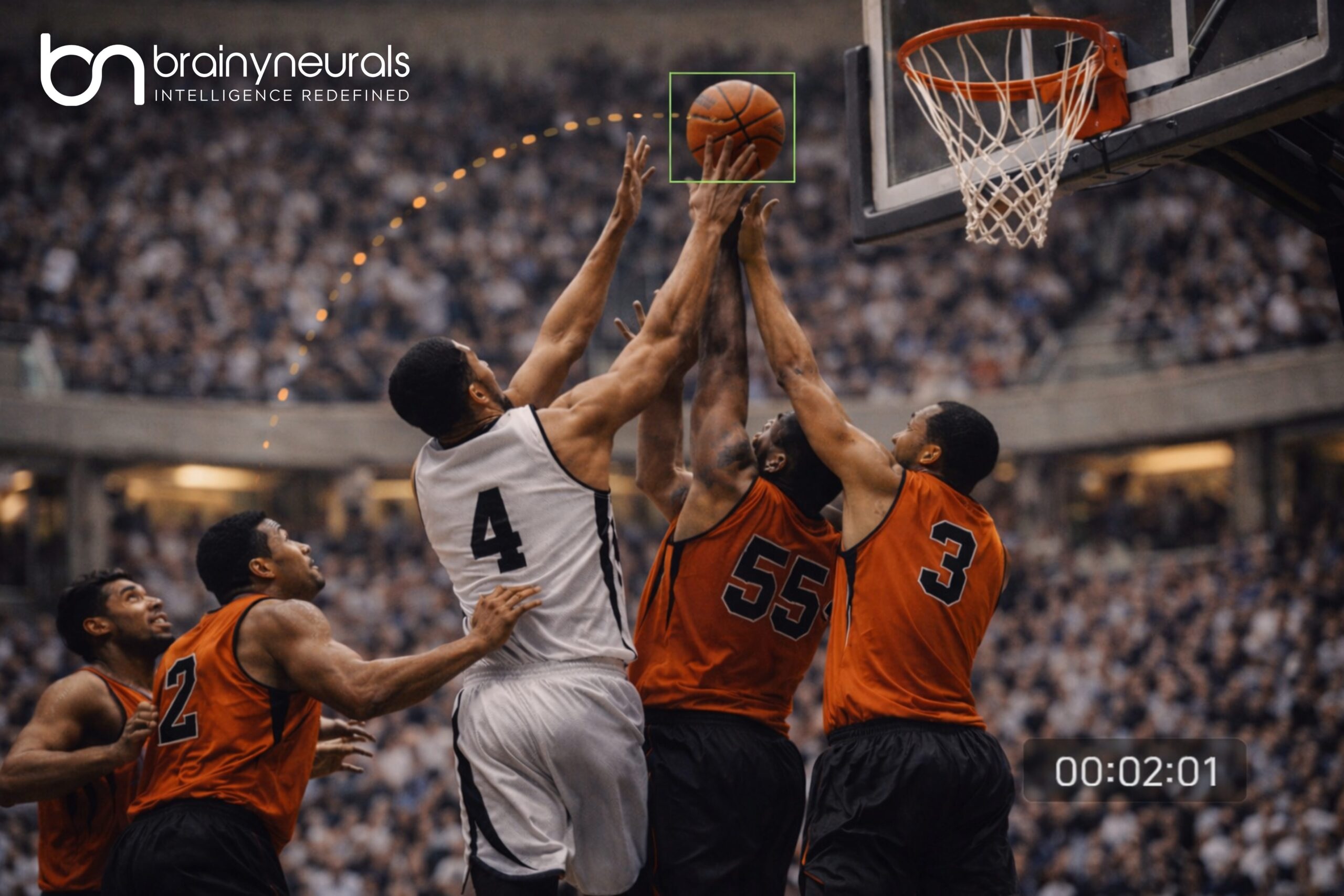
Basketball has always been a fast game. But the modern pace, the quick transitions, spaced offenses, and rapid possession changes has reached a level where even experienced coaching staffs find it challenging to track every detail in real time.
A shot goes up just as the buzzer sounds. A player’s toe grazes the three-point line. A put-back happens so quickly that the scorer’s table is still updating the previous play. These moments are common in today’s game.
For coaches, these aren’t just scoring details. They’re data points that inform substitution decisions, timeout strategies, and post-game analysis. When that information is delayed or uncertain, it creates friction in a workflow that depends on accuracy.
This is where Basketball Analysis Using Artificial Intelligence offers a practical alternative to traditional manual systems.
How Manual Analysis Currently Works
Manual basketball scoring relies on human observation and real-time data entry. Scorekeepers at the table are responsible for tracking multiple elements simultaneously:
- Identifying the shooter and confirming the basket
- Determining whether a shot is worth two or three points
- Recording the score and updating player statistics
- Monitoring the game clock and shot clock
- Listening for referee signals and whistle calls
- Preparing for the next possession
This system has worked for decades. The people managing these responsibilities are skilled and focused on accuracy.
However, the structural challenge is clear: basketball’s tempo has increased significantly, while the human capacity to process and record information in real time has remained constant.
The Impact on Coaching Decisions
Coaching decisions during a game depend on accurate, real-time data. The information coaches rely on includes:
- Score differential: Determines whether to apply defensive pressure or manage clock
- Foul situation: Influences rotation decisions and defensive strategy
- Player performance data: Informs substitution timing and play calling
- Time management: Critical for late-game execution
When this information is delayed or contains small errors, it creates uncertainty in decision-making. A scorekeeper who is one possession behind, or a stat sheet that hasn’t updated a recent foul, can lead to strategic adjustments based on incomplete data.
Over the course of a season, these small inconsistencies accumulate. They affect post-game analysis, player development feedback, and preparation for upcoming opponents.
How Basketball Analysis Using Artificial Intelligence Works
AI-based analysis operates through continuous video processing. The system uses cameras positioned to capture court action, and computer vision algorithms analyze each frame as the game progresses.
The core process includes:
- Ball and rim detection: The system identifies the ball’s position and tracks its movement relative to the rim in every frame.
- Shot confirmation: When the ball passes through the plane of the rim, the system registers a successful basket immediately.
- Player identification: Using jersey recognition and player tracking, the system assigns the basket to the correct player.
- Shot classification: The system analyzes player foot positioning at the moment of release to determine whether the shot qualifies as a two-point or three-point attempt.
- Clock synchronization: All events are timestamped precisely against the game clock.
The key difference from manual systems is consistency. AI processes every frame with equal attention, regardless of game pace or complexity. There is no divided attention, no reaction delay, and no manual entry lag.
Direct Comparison: Manual vs AI Analysis
1. Tracking Missed or Delayed Baskets in High-Speed Sequences
In fast breaks, put-backs, and tip-ins, scoring happens within fractions of a second. In manual systems, scorekeepers may still be updating the previous attempt while the next scoring action is already unfolding.
AI approaches scoring as a measurable physical event. The system continuously tracks the ball’s trajectory relative to the rim plane. When the ball fully passes through the cylinder, the event is recorded immediately.
Using video-based computer vision:
-
The ball is tracked frame by frame.
-
The system confirms full rim-plane intersection.
-
The basket is timestamped instantly and logged with visual evidence.
There is no reaction delay and no dependency on human focus shifting between possessions. This ensures that scoring updates reflect the exact moment the event occurs.

2. Objective 2-Point vs 3-Point Shot Classification
Determining whether a player’s foot was on or behind the three-point line at release is one of the most common gray areas in manual scoring.
Traditional systems rely on visual judgment from the scorer’s angle. AI replaces interpretation with spatial measurement.
At the moment of shot release, the system analyzes:
-
Player positioning through real-time tracking.
-
Court line geometry mapped digitally.
-
Camera calibration data to maintain spatial accuracy.
The classification between two-point and three-point attempts is therefore based on precise positional data rather than memory or angle-based observation.
The result is consistent shot classification, reduced disputes between table and court, and decisions supported by verifiable visual data.

3. Jersey Recognition and Accurate Player Stat Assignment
In crowded paint situations, especially during rebounds and deflections, assigning points to the correct player can be difficult.
Manual systems sometimes rely on quick judgment, which can later require correction.
AI-based jersey recognition and player tracking systems analyze which player interacted with the ball during the scoring sequence. Even in partial obstruction scenarios such as tip-ins or multi-player contests, the system matches the scoring event to the correct jersey number.
This leads to:
-
More accurate individual statistics.
-
Greater trust in performance records.
-
Reduced need for post-game stat corrections.
For coaching staff, reliable player data directly impacts development evaluation and tactical review.

4. Precise Timestamping and Late-Game Event Verification
Close games often hinge on timing, whether a shot left the player’s hand before the buzzer or whether a whistle preceded contact.
Manual systems depend heavily on synchronized observation of multiple events, which can be challenging under pressure.
AI synchronizes:
-
Video frame data.
-
Game clock and shot clock feeds.
-
Audio signals such as whistles and buzzers.
By aligning these inputs precisely, the system can provide objective confirmation of event order. This supports officials and reduces extended match delays in critical situations.
For coaches, this means fewer ambiguities during decisive moments.
Beyond Live Scoring: Post-Game Analysis Benefits
The value of Basketball Analysis Using Artificial Intelligence extends beyond real-time scoring into post-game preparation and player development.
1. Video Review Efficiency
Traditional post-game review requires coaches to manually search through full game footage to locate specific plays, verify statistics, and extract teaching moments. This process is time-intensive and often involves re-watching large portions of the game.
AI systems can automatically isolate and categorize scoring events, creating indexed highlights organized by player, shot type, and game situation. Coaches can access specific sequences directly without manual searching, shifting time allocation from data gathering to strategic analysis.
2. Player Development Applications
Accurate, verifiable statistics improve the quality of individual player feedback. When performance data aligns precisely with video evidence, coaching conversations become more focused and actionable.
For example, if a player’s shooting percentage appears lower than expected, AI-tagged footage allows coaches to quickly review all shot attempts and identify specific technical or situational factors affecting performance. This targeted approach is more efficient than a general film review.
What AI Analysis Does Not Replace
Basketball Analysis Using Artificial Intelligence addresses specific technical limitations in data collection and processing. It does not replace human judgment in areas that require contextual understanding or subjective interpretation.
- Coaching intuition and leadership: AI has no capacity to read team dynamics, assess player confidence, or recognize momentum shifts that aren’t reflected in statistics.
- Officiating judgment: Referees interpret contact, intent, and rule violations based on experience and real-time assessment. AI supports officials with data but does not make judgment calls.
- Strategic thinking: Game planning, tactical adjustments, and in-game decision-making remain entirely within the coach’s domain.
The purpose of AI in this context is to improve the reliability of objective data, scoring accuracy, shot classification, and event timing so that human decision-makers have better information to work with.
When implemented correctly, AI functions as a support layer that operates alongside existing workflows rather than replacing them.
The Broader Context: Why This Matters Now
Basketball’s pace has increased measurably across all competitive levels. What was once characteristic of professional play – rapid ball movement, spacing-oriented offenses, high possession counts; is now standard in high school and grassroots programs.
The infrastructure for tracking and recording these games has not evolved at the same rate. Manual systems designed for slower gameplay are now being asked to manage significantly higher information density.
Research in sports video analytics demonstrates that automated computer vision systems reduce event-detection errors in high-speed environments compared to manual recording processes. This isn’t a theoretical improvement; it’s a measurable gain in data reliability.
For coaches, the practical impact is straightforward: when the information feeding your decisions becomes more accurate and accessible, preparation quality improves.
Implementation Considerations
For coaching programs evaluating Basketball Analysis Using Artificial Intelligence, the focus should be on workflow integration rather than technology complexity.
Effective implementation typically involves:
- Camera infrastructure: Standard video equipment positioned for full-court coverage. In many cases, existing facilities may already have suitable camera systems in place.
- Processing and interface: AI analysis occurs in real time, with results accessible through a straightforward interface designed for coaching staff use during games and review sessions.
- Workflow alignment: The system operates alongside existing scorer’s table operations, functioning as a verification and enhancement layer rather than a replacement.
The goal is not to create additional complexity but to reduce friction in areas where manual processes currently struggle to maintain pace with modern basketball.
Where Coaching Meets Technology
The conversation around Basketball Analysis Using Artificial Intelligence is not about whether technology can outperform human observation. It’s about recognizing that basketball has evolved to a point where manual systems face structural limitations in maintaining real-time accuracy.
AI addresses specific, measurable challenges: reducing scoring delays, improving shot classification accuracy, enabling faster post-game analysis, and providing verifiable data for close-game situations.
For coaches, the practical question is whether reliable, automatically generated data would improve decision-making quality and reduce time spent on manual verification.
The technology exists. The application is proven. The decision is whether it aligns with your program’s needs and priorities.
At Brainy Neurals, we specialize in developing video-based AI systems that integrate seamlessly into live game environments, supporting coaches with reliable, real-time data.
If your program is exploring how Basketball Analysis Using Artificial Intelligence could strengthen coaching preparation and in-game clarity, we’re available to discuss what implementation might look like in your specific environment.